
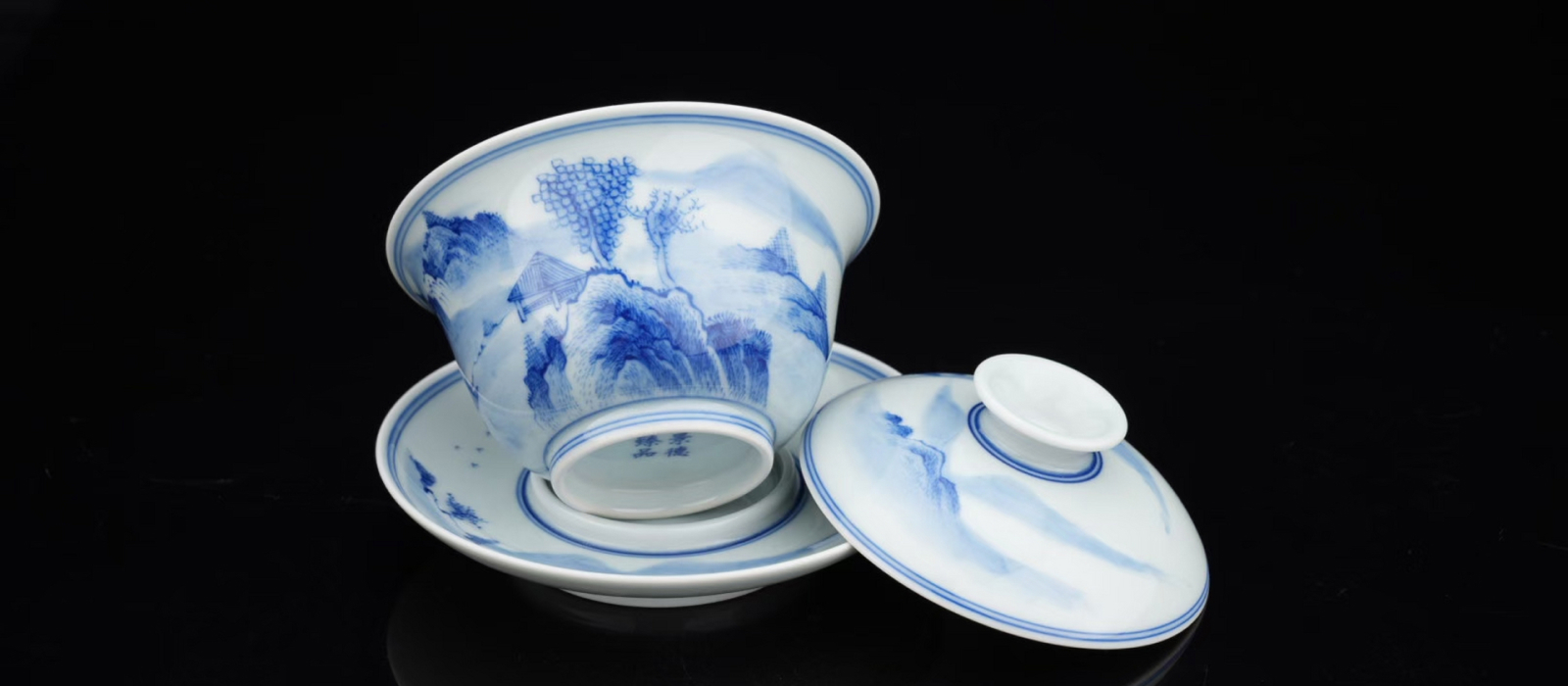
In the distant East, there exists a type of porcelain that intertwines blue and white hues to narrate tales of love spanning millennia. This porcelain, known as “blue and white porcelain,” is a treasure of Chinese ceramic art. Originating around the 7th to 10th centuries (Tang and Song dynasties) and reaching its peak during the 14th to 17th centuries (Yuan, Ming, and Qing dynasties), it is crafted by painting cobalt blue designs on white porcelain bodies, which are then covered with a transparent glaze and fired at high temperatures. Each piece of blue and white porcelain is a testament to the craftsmanship of its maker, embodying rich cultural connotations and deep historical significance.
Today, I will share with you an eternal legend associated with blue and white porcelain.
Around the 14th century (during the Ming Dynasty), there lived a beautiful young woman named Qing’er. She had a profound interest in ceramics from a young age and quickly mastered the art of porcelain-making. However, Qing’er was not content with her achievements. She aspired to create a type of porcelain that had never been seen before, one that could express her loyalty and longing for love.
One day, while gathering herbs in the mountains, Qing’er stumbled upon a peculiar blue mineral. Curious, she crushed it into powder and used it to paint designs on porcelain. After numerous attempts and refinements, Qing’er finally developed a unique blue glaze that produced porcelain with vibrant, fade-resistant colors.
Qing’er named her new creation “blue and white porcelain” and painted a pair of mandarin ducks playing in water on it, symbolizing the beauty and eternity of love. Upon its unveiling, blue and white porcelain caused a sensation and became a highly sought-after collector’s item.
However, Qing’er’s love life was not without obstacles. She fell in love with a scholar named Bai, and the two were deeply in love. Unfortunately, Bai’s family disapproved of their relationship due to Qing’er’s humble background. To prove her love, Qing’er decided to give Bai a meticulously crafted piece of blue and white porcelain as a token of their affection. She believed that as long as their hearts were intertwined, no difficulty or obstacle could hinder their love.
Moved by the porcelain, Bai decided to face his family’s opposition together with Qing’er and bravely pursue their happiness. Ultimately, through their joint efforts, they won the family’s acceptance and married.
From then on, blue and white porcelain became a testament to their love. Whenever people saw the mandarin ducks playing in water on the porcelain, they would recall Qing’er and Bai’s moving love story. And blue and white porcelain, with its unique artistic charm and cultural connotation, has become one of the treasures of Chinese ceramic art.
Today, blue and white porcelain has traversed a thousand years of history. It has witnessed countless loves and sorrows and carries people’s longing and pursuit of a better life. Each piece of blue and white porcelain is a witness to history and the crystallization of a craftsman’s wisdom and hard work. Let us cherish this valuable cultural heritage and let the beauty and legend of blue and white porcelain be passed down forever.